

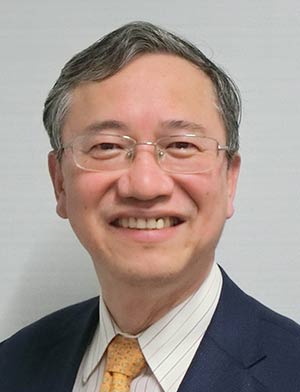
Tomonori Hasegawa is Professor and Chair of the Division of Health Policy and Health Service Research Department of Social Medicine at the Toho University School of Medicine of Japan. He had his medical education at the Tokyo University School of Medicine, where he also received the Doctor of Philosophy. He was previously a Resident at the Tokyo University Hospital in Internal Medicine.
His research activities include health policy analysis, quality and patient safety issue, health economics. He has published 200+ peer-reviewed articles and 100+ books. He was engaged in health sector reform in Japan as an advisory member of the Cabinet Office from 2001 to 2010. He is an executive board member of the Japan Council for Quality Health Care and is responsible for hospital accreditation, a board member of the Japanese Society of Healthcare Management (editor-in-chief of the Journal of Japanese Healthcare Management), and serves as an adviser for the All Japan Hospital Association.
Role of eHealth in Aging Society - Example of Japan
East Asian countries are commonly facing the challenge of population aging and declining birthrates. In Japan, the number and proportion of elderly people are projected to increase until around 2040, when the second baby-boomer generation reaches old age, after which they are expected to stabilize. In an aging society, it is unrealistic for every region to pursue uniform achievement of nationally set standards. Rather, each region should identify its own priority health issues, reach consensus on priorities, and develop and monitor action plans. Establishing an information infrastructure and fostering human resources to support this process have become urgent policy needs.
A common issue that all regions should first address is emergency care for older adults. In many cases, elderly patients visiting emergency departments have relatively mild conditions. Without proper gatekeeping, this can place excessive strain on tertiary emergency centers. Furthermore, when coordination with home-based medical care or long-term care facilities is insufficient, patients tend to remain in emergency centers longer than necessary, causing functional bottlenecks. Because older adults often receive healthcare services from multiple institutions, the standardization of medical information and the establishment of interoperable data systems play a crucial role.
Until now, Japan’s health policy has focused on securing the healthcare delivery system to meet increasing medical demand, emphasizing the need to ensure sufficient numbers of healthcare professionals in each occupation. However, such measures are no longer realistic. Toward 2040, the key will be to regard the available healthcare workforce as the major limiting factor and to seek the optimal combination of healthcare services deliverable within that constraint. The introduction of eHealth should also be promoted in this context. This paper introduces Japan’s current situation regarding the development of region-based care coordination and the role of eHealth within it, rather than focusing solely on facility-based care.